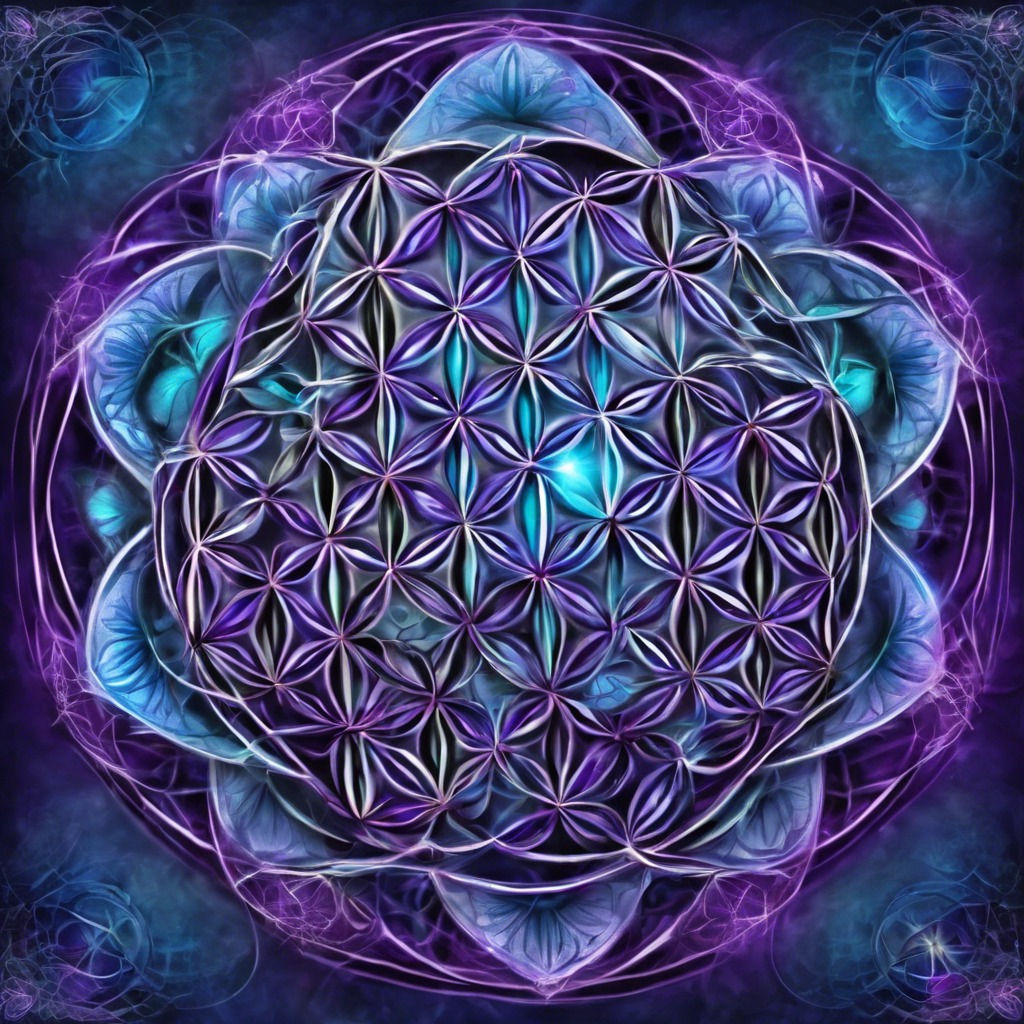
The Flower of Life
Evelynn Road

The Flower of Life stands as one of the most captivating and enigmatic symbols in the realm of sacred geometry. Its intricate pattern of overlapping circles has fascinated scholars, artists, and spiritual seekers for centuries, evoking a sense of awe and wonder at the intricacies of the universe. But what exactly is the Flower of Life, and what secrets does it hold?
The origins of the Flower of Life can be traced back to ancient civilizations across the globe, from Egypt and Mesopotamia to Greece and China. Its symmetrical design, consisting of multiple evenly spaced circles arranged in a hexagonal pattern, suggests a profound understanding of geometry and mathematics among ancient cultures.
Symbolically, the Flower of Life is believed to represent the interconnectedness of all living beings and the underlying unity of creation. The overlapping circles symbolize the fundamental interconnectedness of life and the infinite cycles of birth, death, and rebirth that permeate the cosmos. In some traditions, the Flower of Life is also associated with the concept of sacred femininity, representing the divine feminine energy that nurtures and sustains all life.
In the realm of sacred geometry, the Flower of Life holds immense spiritual significance. It is often regarded as a symbol of creation and the underlying geometric framework upon which the universe is built. According to some interpretations, the Flower of Life encapsulates the geometric patterns that underlie all of existence, from the formation of galaxies to the structure of atoms.
Many spiritual traditions and esoteric teachings incorporate the Flower of Life into their practices, viewing it as a potent symbol for meditation, healing, and spiritual growth. Some believe that meditating on the intricate patterns of the Flower of Life can lead to profound insights and a deeper understanding of the interconnected nature of reality.
In addition to its spiritual significance, the Flower of Life has found practical applications in various fields, including art, architecture, and mathematics. Its mesmerizing geometric pattern has inspired artists, architects, and designers across cultures, serving as a source of inspiration for intricate mandalas, sacred architecture, and geometric patterns in decorative art.
In modern times, the Flower of Life continues to captivate the imagination of seekers and scholars alike, prompting exploration into its deeper meanings and practical applications. Whether viewed as a symbol of spiritual unity, a blueprint for creation, or a mathematical marvel, the Flower of Life remains a timeless symbol that invites contemplation and exploration into the mysteries of existence.
How to incorporate the Flower of Life into your own life
Meditation: Many people use the Flower of Life as a focal point for meditation. You can either visualize the pattern in your mind's eye or use a physical representation of it, such as a printed image or a sacred object engraved with the pattern. As you meditate, focus on the intricate details of the Flower of Life and allow it to guide you into a deeper state of consciousness.
Visualization: Visualizing the Flower of Life can be a powerful way to connect with its energy and symbolism. You can imagine the pattern surrounding you or expanding outward into the universe, bringing a sense of harmony and interconnectedness to your awareness.
Manifestation: Meditating on the Flower of Life can help align your thoughts and intentions with the creative forces of the universe, making it a potent tool for manifestation. As you focus on the pattern, visualize your desires with clarity and intention, trusting that the universal energies will support you in bringing them into reality.
Sacred Space: You can incorporate the Flower of Life into your living or working space as a sacred symbol. You may choose to display artwork or decorative items featuring the pattern, or even create your own artwork inspired by it. Surrounding yourself with the Flower of Life can help imbue your environment with a sense of balance, harmony, and spiritual energy.
Spiritual Healing: You can place the pattern on or near areas of the body that need healing or use it as a focal point during energy healing practices such as Reiki or chakra balancing.
Remember that the effectiveness of using the Flower of Life ultimately depends on your personal beliefs, intentions, and practices. Experiment with different ways of incorporating the pattern into your spiritual or meditative practices to discover what resonates most with you.